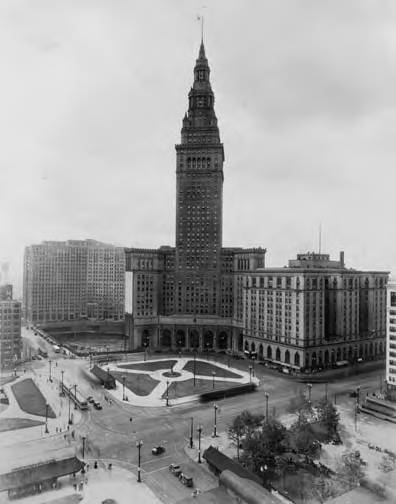
Euclid Avenue looking east · c. 1900, in its final grand decade
In the Archive · 1855 to 1930
Between 1855 and 1930, a four-mile stretch of Euclid Avenue running east from Public Square was home to what contemporary observers agreed was the greatest concentration of residential architecture in the United States. At its peak, Millionaires' Row held more than forty mansions belonging to the founders of the industries that made Cleveland the fifth-largest city in America. Within a single decade — the 1920s — almost all of them were gone.
The first Euclid Avenue mansion of consequence was built in 1855 by Samuel Mather Sr., a founder of Cleveland-Cliffs. The neighborhood grew rapidly through the following decade. After the Civil War, as Cleveland's steel, oil, shipping, and rail fortunes consolidated, Euclid Avenue became the automatic choice for any industrialist building a principal residence. By 1880 the avenue held the homes of John D. Rockefeller, Jeptha Wade, Charles Brush, Samuel Mather Jr., Leonard Hanna, Amasa Stone, Dan Hanna, Worcester Warner, Ambrose Swasey, Henry Payne, Leonard Case Jr., and dozens of others.
The houses were ambitious by any standard. Most were set back from the street behind broad lawns with mature elms. Styles ranged from Italianate (the Rockefeller house) to High Victorian Gothic (the Wade house) to Richardsonian Romanesque (the Hay-McKinney house) to Beaux-Arts (the Hanna house). The Samuel Andrews house — Andrews was Rockefeller's partner in Standard Oil — was the grandest: a hundred rooms, a great hall, a ballroom that seated 600 people, completed in 1885 and nicknamed "Andrews' Folly" almost immediately because it was so large it was almost impossible to staff.

Of the forty-plus great houses of Millionaires' Row, the ones below are among the most architecturally and historically consequential. Most are gone.
John D. and Laura Rockefeller's Cleveland home for 35 years. A relatively modest Italianate by the standards of the Row; the family's summer home at Forest Hill was grander.
Jeptha Wade's house, the original master of Western Union Telegraph and the benefactor whose land donation made the Cleveland Museum of Art possible.
45-room Tudor Revival on a 3.5-acre parcel. The iron magnate's third Euclid Avenue residence and the last great Row mansion. Now the Mather Mansion at Cleveland State University.
"Andrews' Folly." 100 rooms, 600-seat ballroom, 100 feet of frontage. The Standard Oil partner spent so much building it he could barely afford to live there.
The inventor of the arc lamp. The first private residence in the United States to be fully electrically lit, with Brush's own dynamos powering every room from 1879 onward.
Brother of Mark Hanna, the kingmaker of the Republican Party. A Beaux-Arts mansion that later became the site of the Cleveland Play House.
Stone, of the Ashtabula Disaster notoriety, built this residence for his daughter Clara before her marriage to John Hay — Lincoln's private secretary and later US Secretary of State.
Now the home of the Cleveland History Center and the Western Reserve Historical Society. One of the only surviving intact Row mansions open to the public.
By the 1910s the mansions were beginning to be abandoned. The Rockefellers had decamped to New York in 1884; other industrial families followed to Shaker Heights, Hunting Valley, Gates Mills, and the Van Sweringen-planned suburbs of the east-side Heights. The commercial encroachment of downtown, moving steadily east along Euclid, made quiet residential occupation increasingly unpleasant.
The demolition wave began in earnest in the mid-1920s, was briefly slowed by the 1929 crash, and resumed in the 1930s as estate taxes, deferred maintenance, and falling real-estate values made the great houses economically unsustainable. Most were replaced by commercial structures or, with time, by nothing at all — just surface parking.
By 1940 the avenue had lost more than thirty mansions. By 1960, fewer than a dozen remained. Today, of the roughly forty great houses of the Row's peak period, six survive: the Mather Mansion (now part of Cleveland State University), the Hay-McKinney House (now the Cleveland History Center), the Drury House (still a private residence), and three smaller homes in various institutional uses. The scale of the loss is among the most severe in American architectural history, comparable to the demolition of Fifth Avenue's Vanderbilt houses in New York or the grand houses of Beacon Street in Boston.
The physical disappearance of Millionaires' Row is part of the reason Cleveland's architectural memory leans so heavily on its civic buildings — Terminal Tower, the Cleveland Museum of Art, the Arcade — rather than on its residences. Few American cities had more great residential architecture in 1900; few have less in 2025.
What the mansions left behind are the institutions their occupants funded. Wade Park and the Cleveland Museum of Art exist because of the Wade family. Lake View Cemetery, where most of the Row's residents are buried, was developed by them as the city's premier burying ground. Case Western Reserve's campus, the Cleveland Museum of Natural History, Severance Hall, the Garfield Memorial, the Hanna Building, Playhouse Square — each institution carries forward the names of men who once lived, and died, on four miles of Euclid Avenue that no longer exists.
The Archive