John D. Rockefeller
The most consequential industrialist in American history, and the single figure most responsible for Cleveland's nineteenth-century transformation from a Great Lakes port into a national industrial capital. Rockefeller founded Standard Oil in Cleveland on January 10, 1870. By 1880 it controlled 90% of oil refining in the United States.
Rockefeller lived in Cleveland for 55 years, raised his family here, built his first great fortune here, and donated the land that became Rockefeller Park and Forest Hill. At his death in 1937 he was, inflation-adjusted, the wealthiest private individual in American history — a fortune that began, definitively, on the banks of the Cuyahoga.
Cleveland, 1853
John Davison Rockefeller was born in 1839 in Richford, New York, the son of William "Big Bill" Rockefeller, an unscrupulous itinerant medicine salesman, and Eliza Davison Rockefeller, a devout Baptist who raised six children largely alone. The family moved several times before settling in Strongsville, Ohio, in 1853. John was 14. He finished high school at Central High School in Cleveland in 1855 and took a bookkeeping course at Folsom's Commercial College, his entire formal education.
His first job, beginning September 26, 1855 — a date he would celebrate every year for the rest of his life as "Job Day" — was as an assistant bookkeeper at the Cleveland commission firm Hewitt & Tuttle, where he earned $3.57 per week. By age 20 he had saved $1,000. He and a partner, Maurice Clark, opened their own commission house in 1859; by 1862 they had expanded into oil refining at a works in the Flats.
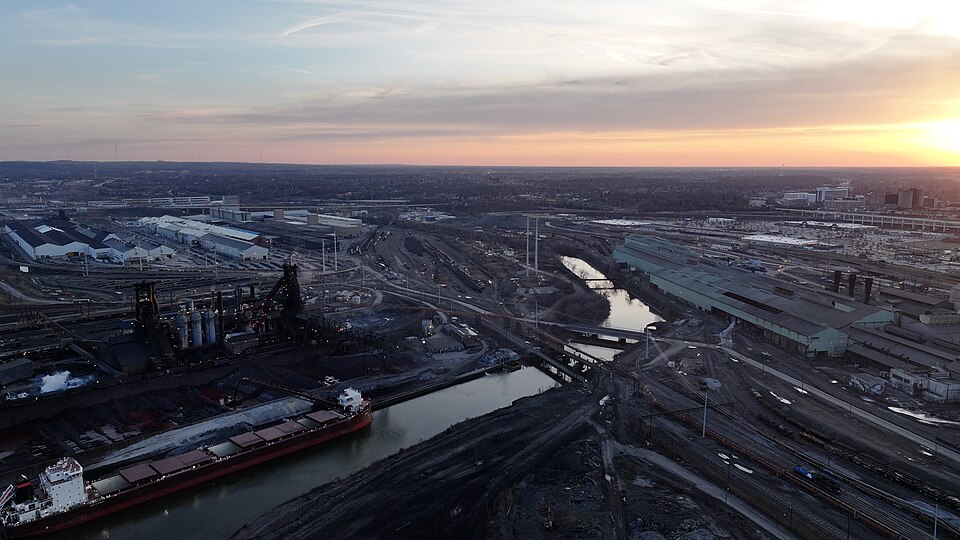
Oil at that moment was a new industry. The first commercially productive well had been drilled by Colonel Edwin Drake at Titusville, Pennsylvania, in August 1859 — a hundred miles east of Cleveland. The crude that came out of the Pennsylvania oil regions needed to be refined, and Cleveland's position on the Great Lakes, with access to rail and water shipping, made it a natural refining center. By 1866, Cleveland had thirty refineries. Rockefeller's was among the largest.
The Founding of Standard Oil

On January 10, 1870, Rockefeller and his partners (Henry Flagler, Samuel Andrews, William Rockefeller, and Stephen Harkness) incorporated the Standard Oil Company of Ohio with $1 million in capital. The company's refineries were in Cleveland; its business strategy was scale, efficiency, and a ruthless use of rail-shipping rebates to undercut competitors.
In February 1872, what became known as the "Cleveland Massacre" reshaped American industry in the course of six weeks. Rockefeller systematically approached the owners of the other major Cleveland refineries and offered them the choice of selling to Standard Oil on generous terms or being driven out of business by his rail-rebate advantages. Of the 26 independent Cleveland refineries operating at the start of 1872, 22 sold to Standard Oil by the end of March. Among those who sold was Rockefeller's own brother, Frank.
Within a year of the Cleveland Massacre, Standard Oil controlled more than a quarter of national refining. By 1880 it controlled roughly 90%. Rockefeller's innovation was not in the chemistry of refining; it was in the organizational architecture of a national industrial corporation, built on a combination of vertical integration (Standard owned wells, pipelines, tank cars, refineries, and distribution), scale economies, and the calculated use of financial pressure. It became the template for every subsequent American industrial trust.
Life on Euclid Avenue
For 35 years, the Rockefeller family home at 997 Euclid Avenue anchored the eastern end of Millionaires' Row. The house was modest by the standards of the boulevard — the Mathers, the Hannas, and the Severances all built grander — but for nearly all of that period Rockefeller was the richest man in the city, and from 1880 onward, the richest man in the country.
He and his wife, Laura Celestia "Cettie" Spelman Rockefeller, raised their five children in Cleveland and attended Erie Street Baptist Church (later Euclid Avenue Baptist Church). Rockefeller was a consistent, methodical tither throughout his life; by the 1870s he was already giving away more than $50,000 a year. In 1880 he purchased Forest Hill, a 700-acre estate in East Cleveland, as the family's country residence. Forest Hill included a working farm, a golf course (one of the earliest in Ohio), and gardens; the Rockefellers spent summers there through the 1910s.
In 1884, the family's primary residence shifted to New York, closer to Standard Oil's expanding corporate operations at 26 Broadway. Rockefeller retained Forest Hill and continued returning to Cleveland regularly through the 1910s. The Euclid Avenue house was demolished after his wife's death in 1915. The Forest Hill mansion was demolished in 1938 following a fire. A portion of the Forest Hill estate was donated to the cities of Cleveland Heights and East Cleveland; it remains a public park.
The Philanthropy
Rockefeller's philanthropic giving was on a scale the country had not seen. By the time of his death in 1937 he had given away approximately $540 million (roughly $12 billion in 2025 dollars). Most of it was concentrated in a handful of strategic targets: medical research (the Rockefeller Institute for Medical Research, 1901), higher education (the University of Chicago, founded 1890 with a $35 million Rockefeller gift), and public health (the Rockefeller Sanitary Commission for the Eradication of Hookworm, 1909).
In Cleveland, his donations were substantial but largely quieter than the institutional giving of his peers. He donated the land that became Rockefeller Park, the 276-acre linear park along Doan Brook connecting University Circle to the lakefront; the gift was formalized in 1896. He funded Case Western Reserve University through the Rockefeller Foundation and was a steady benefactor of Euclid Avenue Baptist Church and the Cleveland YMCA.

He is buried at Lake View Cemetery in Cleveland, under a 70-foot granite obelisk that is the tallest monument in the cemetery. The graves of Jeptha Wade, Samuel Mather, Leonard Hanna, Charles Brush, and James Garfield surround his; the cemetery is, in effect, the final address of most of the men and women who built the Cleveland of the Gilded Age.
Rockefeller Timeline
- Born1839
July 8. Richford, New York. - Family Moves to Ohio1853
The Rockefellers settle in Strongsville; John finishes Cleveland Central High School. - First Job1855
September 26. Junior bookkeeper at Hewitt & Tuttle. $3.57 per week. - Enters Refining1863
Partners in Andrews, Clark & Company oil refinery in the Cleveland Flats. - Marriage1864
Marries Laura Celestia "Cettie" Spelman in Cleveland. - Standard Oil Founded1870
January 10. Rockefeller, Flagler, Andrews, and the Rockefeller brothers incorporate Standard Oil of Ohio. - The Cleveland Massacre1872
February–March. Standard acquires 22 of 26 Cleveland refineries in six weeks. - Forest Hill Purchased1880
700-acre estate in East Cleveland becomes the family's summer home. - Family Relocates to New York1884
Primary residence moves east with Standard Oil's expanding operations. - Rockefeller Park Donated1896
276 acres of land along Doan Brook given to the City of Cleveland. - Rockefeller Institute for Medical Research1901
Founded in New York; becomes the Rockefeller University. - Standard Oil Dissolved1911
May 15. Supreme Court orders breakup of Standard Oil into 34 successor companies. - Death1937
May 23. Dies at age 97 in Ormond Beach, Florida. Buried at Lake View Cemetery.