Terminal Tower · Public Square, Cleveland
In the Archive · Landmark
Dedicated June 28, 1930 · 708 feet · 52 stories
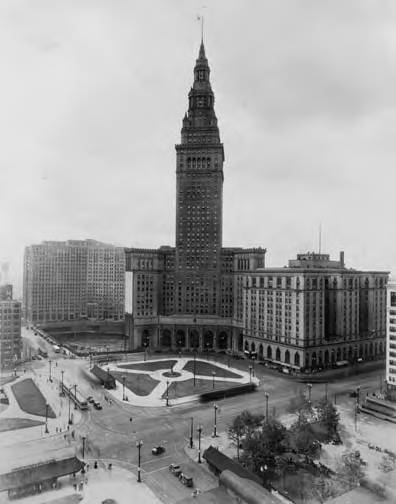
When Terminal Tower was completed in 1930, it was the tallest building in the world outside New York City and the fourth-tallest building anywhere. More importantly for Cleveland, it was the civic anchor of a 52-story real-estate complex that consolidated five railroads beneath a single concourse and changed the city's relationship to its own skyline. Nearly a century later, every image of the Cleveland skyline still organizes itself around this building.

Terminal Tower was the work of Oris Paxton and Mantis James Van Sweringen, two unmarried brothers who lived together and ran the Cleveland real-estate empire they built from scratch. The Van Sweringens began as small-scale developers in the early 1900s, acquired the land for what would become the planned suburb of Shaker Heights, and built their fortune around a rapid-transit rail line connecting downtown Cleveland to their real estate in the east-side heights.
That interurban line, the Cleveland Interurban Railroad (later the Shaker Rapid), needed a downtown terminal. Rather than building a standalone train shed, the Van Sweringens proposed a far more ambitious plan: consolidate five railroads — the Nickel Plate, the Erie, the Baltimore & Ohio, the New York Central, and their own Shaker Rapid — beneath a single concourse at the southwest corner of Public Square, with a skyscraper above it as the architectural anchor.
The architects were Graham, Anderson, Probst & White of Chicago, successors to D.H. Burnham & Company. The design is a late-Beaux-Arts skyscraper in the tradition of the Municipal Building (1914) and the New York Municipal Building (1914): a stepped tower with a pyramidal cap, classical detailing, and a steel frame clad in Indiana limestone.
The engineering was extraordinary for its moment. The tower sits on more than a thousand piles driven through the downtown bluff's soft clay to bedrock 200 feet below. Construction began in 1926 and took four years. Contemporary accounts marveled at the complexity of working around five active rail lines in a densely occupied downtown. The Van Sweringens' real-estate empire collapsed in the aftermath of the 1929 stock market crash; both brothers were effectively insolvent by the time of the tower's dedication in June 1930, though the tower bore their vision regardless.
From 1930 until rail travel's decline in the 1960s, Cleveland Union Terminal was one of the busiest railroad stations in the country, handling 400 passenger trains a day at its peak. The concourse below the tower was a landmark in its own right — a barrel-vaulted grand hall with gold-leaf ornament, marble floors, and a line of ticket booths that felt closer to Grand Central than to a Midwestern commercial railroad. Through the 1940s and 1950s, nearly every major figure in American life — presidents, heads of state, athletes, entertainers — passed through the Union Terminal concourse at some point.
As rail traffic declined, the terminal complex was gradually emptied. The intercity rail operations ceased by 1977. Amtrak moved to a lakefront station in 1977. Only the Shaker Rapid continued to use the underground concourse.
In 1990, after a decade of planning and a $400 million investment, the complex reopened as Tower City Center. The rail concourse was converted into a three-level enclosed shopping mall; the office tower continued in use; the two Beaux-Arts wings flanking the tower became hotels (Ritz-Carlton Cleveland and Marriott). It was, at the time, the largest adaptive-reuse project in US history.


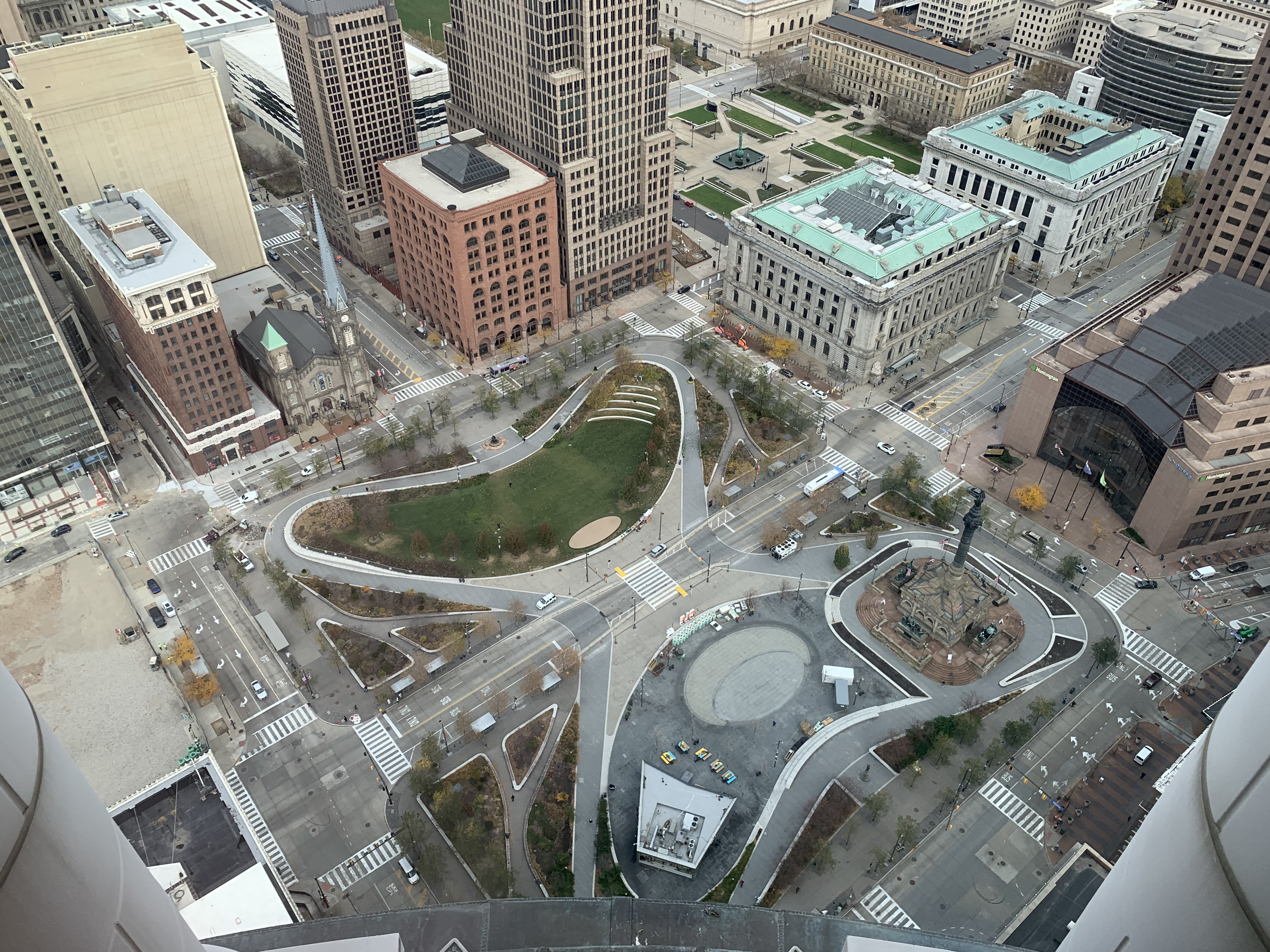
Terminal Tower remained the tallest building in Cleveland, and the tallest building between New York and Chicago, for 61 years — until the Key Tower (designed by Cesar Pelli) overtopped it in 1991. In civic terms, however, it has never been surpassed as the defining element of the skyline. Every chamber-of-commerce photograph, every weather-report backdrop, every postcard, every skyline view from the lake uses Terminal Tower as its organizing vertical. The observation deck on the 42nd floor, closed from 1976 to 2006 and reopened intermittently since, draws tens of thousands of visitors per year.
The tower's pyramidal cap is illuminated nightly in colors corresponding to sporting events, holidays, and civic observances. For Clevelanders who grew up within sight of it, the color of Terminal Tower at night is a kind of citywide signal — a daily, ambient form of civic communication that few other American cities possess.
The Archive