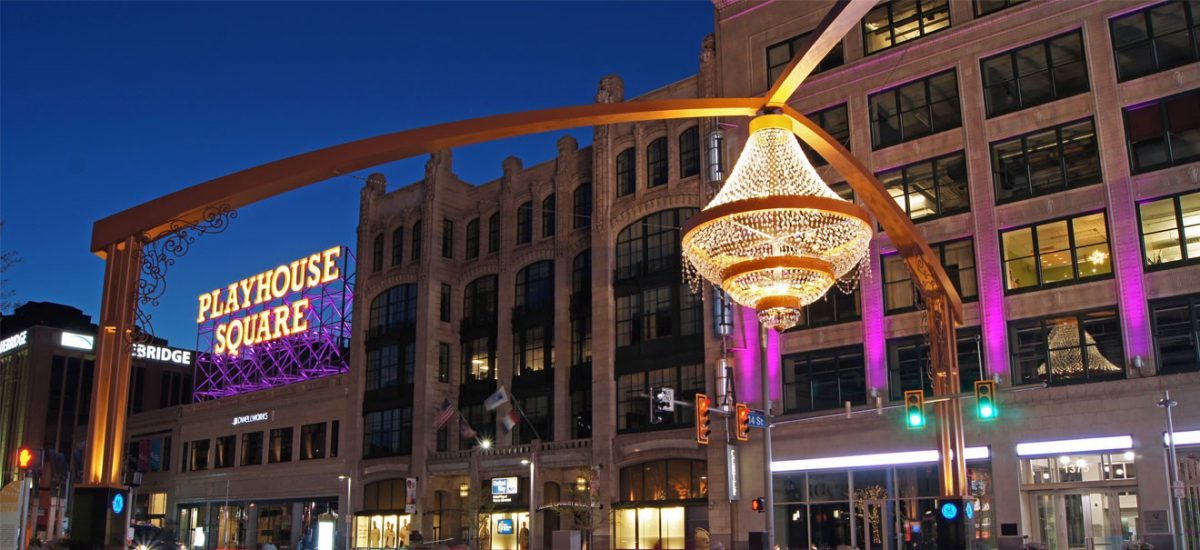
Playhouse Square at Euclid & East 14th · The chandelier installed 2014
In the Archive · 1921 to Present
Between February 1921 and January 1922 — a span of eleven months — five grand theaters opened within a single block of Euclid Avenue in downtown Cleveland. They were, for a generation, the grandest theater district in America outside Times Square. By 1970 four of the five were shuttered and slated for demolition. By 1972 a volunteer campaign had halted the wrecking ball. What followed became the largest historic theater preservation effort in United States history.
Cleveland in 1920 had just become the fifth-largest city in the United States, with a population approaching 800,000 and industrial wealth that had quadrupled since the turn of the century. The city's downtown retail corridor along Euclid Avenue had matured into a dense, prosperous district comparable to Chicago's State Street or Philadelphia's Market Street.
Five separate theater-chain operators saw the opportunity within months of each other. The State opened February 5, 1921. The Ohio opened February 14, 1921, only nine days later. The Hanna followed on March 28, 1921. The Allen opened April 1, 1921. The Palace, the largest and most lavish, opened on November 7, 1922. Five theaters, eight city blocks of combined marquee frontage, and a daily audience of more than 10,000 people within walking distance of Public Square.
The theaters were vaudeville-and-film houses built during the format's last great boom. Each was staffed by orchestras, ushers, pipe organists, and stage crews; each presented five or six shows daily; each had its own distinct interior treatment (the State's Italian Renaissance, the Ohio's Italian Gothic, the Palace's French Baroque). The architect for four of the five — Thomas Lamb, working from New York — was perhaps the most accomplished theater designer of his generation.

The decline began after the Second World War and accelerated rapidly through the 1950s. Television, suburbanization, and the collapse of the vaudeville-plus-film business model hollowed out the downtown theater economy. The Allen, the Hanna, the Ohio, and the State were all dark by 1969. Only the Palace struggled on as a second-run film house, and even that closed by 1972.
A Manhattan-based theater-chain owner, the Loew's organization, which held the leases on several of the theaters, filed notice with the City of Cleveland in 1970 of its intent to demolish the four dark theaters and replace them with a parking garage. The Hanna, owned separately, was also slated for demolition. Demolition permits were issued. The date for the wrecking ball was the spring of 1972.
Ray Shepardson was a 27-year-old former high school teacher and civic-affairs staffer who had wandered into the abandoned State Theatre in late 1970 on a routine errand and been overwhelmed by what he saw: a fully-intact 3,400-seat Italian Renaissance theater, organ and all, darkening in a deserted downtown a week before its scheduled demolition. He spent the next eighteen months trying to save it.
Shepardson's breakthrough was a three-act cabaret revue titled The Jacques Brel Is Alive and Well and Living in Paris Cabaret, staged in the State Theatre's grand foyer beginning on July 18, 1973. The show cost $12,000 to mount. It ran for 522 performances over three years, drew over 115,000 paying customers, generated more than $1 million in revenue — enough to pay the theater's holding costs and establish a permanent nonprofit preservation organization, the Playhouse Square Association (later the Playhouse Square Foundation).
The Loew's demolition order was withdrawn. The four theaters remained standing. Restoration proceeded through the 1970s and 1980s, a theater at a time, funded by a combination of Ohio Historic Tax Credits, philanthropy, and the Association's ongoing cabaret and rental revenue. The State reopened for full-scale theatrical production in 1984; the Ohio in 1982; the Palace in 1988; the Allen in 1998.
The largest of the five. Italian Renaissance interior, marble foyer extending 320 feet deep — the longest theater lobby in the world. Home of the preserved State Theatre cabaret that saved the district.
Italian Gothic interior with remarkable ceiling murals. Rebuilt after a 1964 fire that destroyed the original interior; the current Ohio is a meticulous 1982 recreation of the 1921 design.
Commissioned by Dan R. Hanna in memory of his father, Senator Mark Hanna. Restored 2008 as the home of smaller-scale and Broadway-touring productions. The only one of the five not designed by Lamb.
The only one of the five originally designed as a movie palace rather than a vaudeville house. Restored 1998 as a 2,500-seat live theater; hosts large-scale Broadway productions.
The most lavishly decorated. Keith-Albee vaudeville circuit flagship. French Baroque interior: gilded proscenium, marble grand staircase, crystal chandeliers. Restored 1988.
In 2014, as part of a larger district-level streetscape improvement, Playhouse Square Foundation commissioned and installed a 20-foot crystal chandelier suspended directly over the Euclid Avenue intersection at East 14th Street. The GE Gateway Chandelier is reportedly the largest outdoor chandelier in the world: 4,200 crystals, 25 feet in diameter, illuminated 24 hours a day, visible from a mile in every direction.
The piece was controversial at commissioning — a large outdoor chandelier over a city street was not the kind of civic gesture American cities had recently made — and became almost immediately one of Cleveland's most-photographed landmarks. In 2024 it was added to the formal inventory of Cleveland's Cultural Gardens of the lakefront and boulevards.
The district today hosts more than a million patrons annually across the five theaters, making it the second-largest performing arts center in the United States after Lincoln Center in New York. Its survival, and its present scale, remain a remarkable piece of volunteer-organized civic accomplishment.
The Archive
Every street, every fire, every forgotten face. The stories that don't make the headlines are often the ones worth keeping.