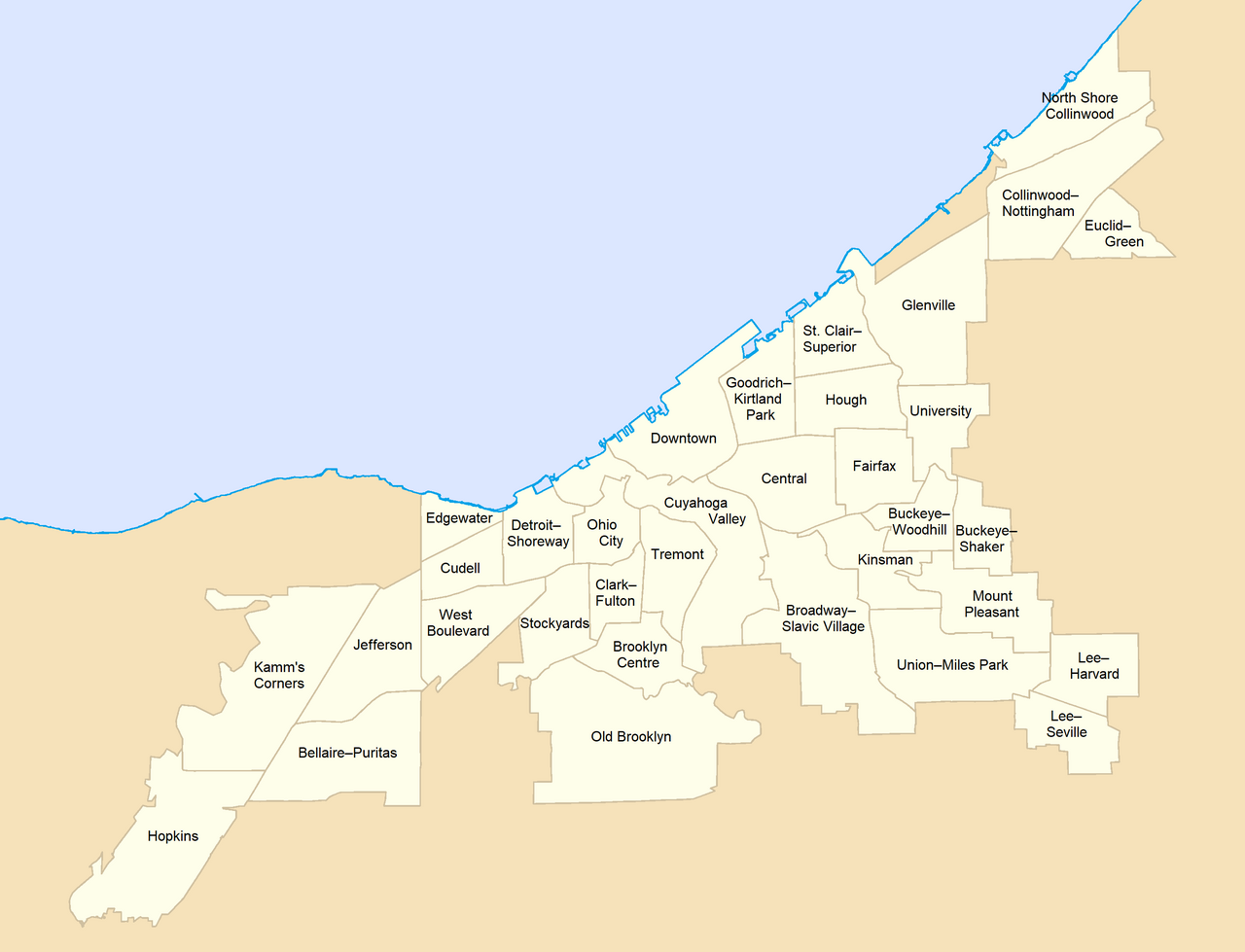
Cleveland's neighborhood fabric · Each block a chapter of its own
In the Archive · 1880 to Present
Cleveland has never been a single city. It has always been a federation of neighborhoods, each with its own church steeple, its own dialect of English layered over its own mother tongue, its own bakery and butcher and funeral home. The city's grandest boulevards tell the public story; the neighborhoods are where it actually happened.
By 1920, when Cleveland reached its peak population of 796,000, roughly a third of its residents were foreign-born and another third were the children of immigrants. Irish and German arrivals in the 1840s and 1850s were followed by successive waves: Czechs, Poles, Hungarians, Italians, Slovaks, Slovenes, Jews fleeing Russian pogroms, Greeks, Syrians, Lebanese. African Americans arrived in significant numbers during the Great Migration of the 1910s and 1920s, drawn by industrial jobs and fleeing the Jim Crow South. Puerto Ricans came after World War II. Each group built its neighborhood institutions in its own quarter of the city, and the city's map became a kind of atlas of the twentieth century.
What is true of Cleveland's neighborhoods is that they were never static. Germans who built Ohio City in the 1850s moved east by the 1900s, replaced by Irish and then by Appalachian migrants and then by Ohioans from elsewhere and then by young people priced out of the coasts. Hough was built as a streetcar suburb for the middle class, became a Black neighborhood in the 1940s under the pressures of restricted housing covenants elsewhere, was torched by uprising and then by arson and then by abandonment, and is now (haltingly, partially) being rebuilt. The neighborhoods tell the story of the city precisely because they never stopped changing.
West Side · Established 1818
Incorporated as a city in 1836 · Annexed to Cleveland 1854
Ohio City was founded as a rival to Cleveland itself, platted on the west bank of the Cuyahoga by land speculators who expected the river's west side to become the dominant commercial center. The "Bridge War" of 1837 — a months-long dispute over who controlled the Columbus Street Bridge — ended with cannon fire and federal intervention, and the annexation of Ohio City by Cleveland in 1854 ended the rivalry once and for all.
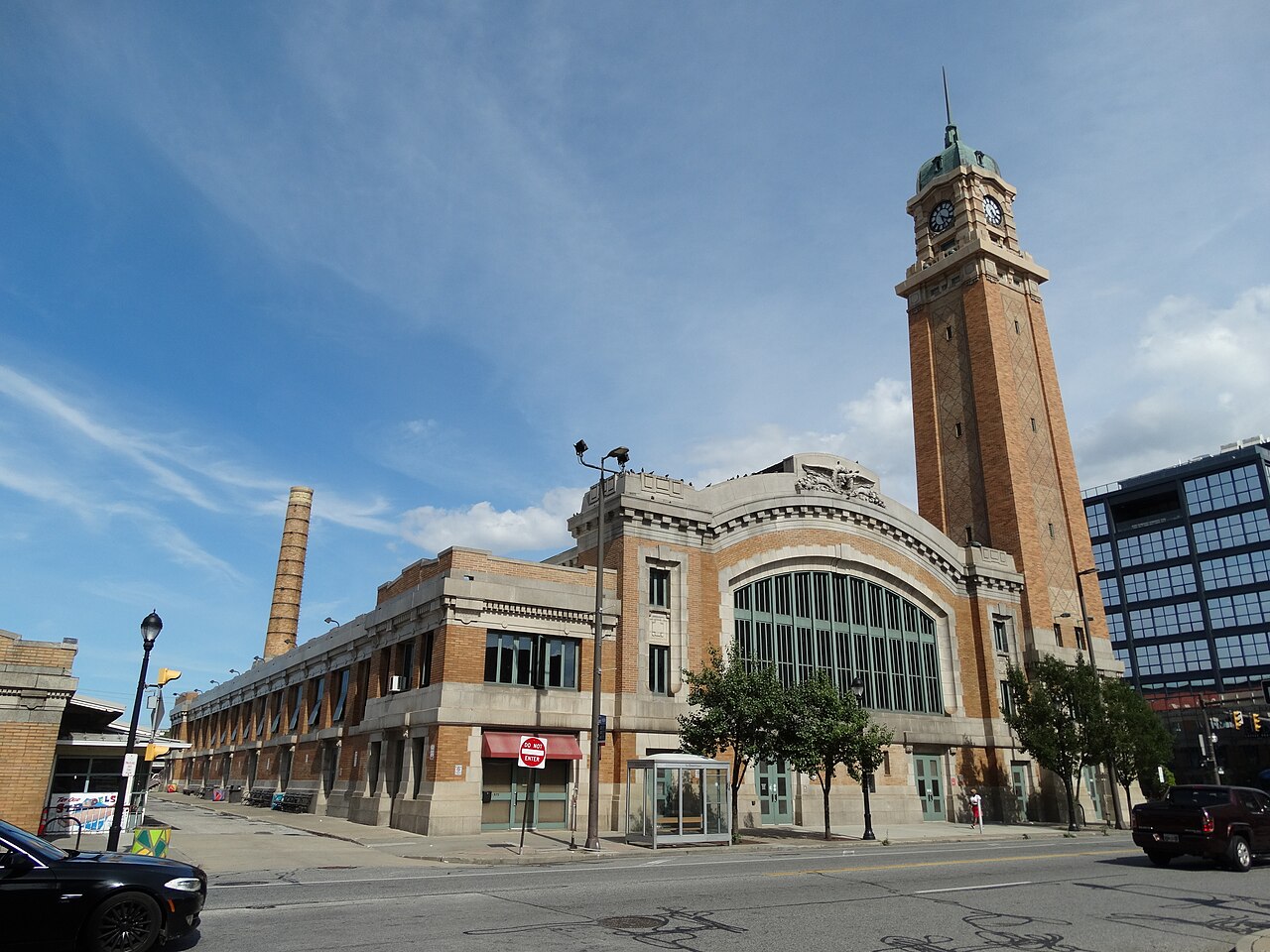
Today's Ohio City is anchored by the West Side Market (a 1912 Beaux-Arts public market still operating continuously) and a dense walkable grid of restored Victorians and Italianate commercial storefronts. The craft brewery revival of the 2000s and 2010s — Great Lakes Brewing, Market Garden, Nano Brew — transformed the neighborhood into one of the most visited restaurant districts in the Midwest.
West Side · Established c. 1830
Historic Polish, Ukrainian & Greek parish district
Tremont occupies a high bluff above the industrial Flats, directly across the river from downtown. For a century it was the city's most densely parish-organized neighborhood: churches of five different Eastern European traditions still stand within a half-mile radius of Lincoln Park. St. Theodosius Russian Orthodox Cathedral, whose thirteen copper domes were modeled on the Church of Our Savior in Moscow, was famously used as the setting of The Deer Hunter (1978).
By the 1970s and '80s, Tremont had lost most of its working-class population to the suburbs and was among the most depressed neighborhoods in the city. An artist-led revival beginning in the late 1990s — anchored by monthly gallery walks, the Tremont West Development Corporation, and a wave of independent restaurants — transformed it into one of Cleveland's most-visited residential neighborhoods.

East Side · Established 1799
Site of the Hough Uprising, July 1966
Hough was originally a farming hamlet and then, by the 1890s, one of Cleveland's most desirable middle-class streetcar suburbs: substantial brick homes, wide avenues lined with elm trees, institutional neighbors including University Circle. Restrictive covenants and racial zoning channeled most of Cleveland's post-1940 Black population into Hough, and by 1960 the neighborhood was roughly 75% Black and badly overcrowded.
On the evening of July 18, 1966, a confrontation at a corner bar at East 79th and Hough Avenue triggered six days of unrest during which four residents died and hundreds of buildings burned. The Hough Uprising was the second major urban uprising of that summer (after Watts, 1965) and one of the events that prompted federal urban policy reform. The neighborhood never fully recovered from the combined effects of the uprising, the subsequent arson wave, and decades of disinvestment. The 1990s and 2000s brought slow rebuilding — a mix of subsidized new housing and Case Western Reserve's eastward expansion — but Hough remains one of the most visible examples in the country of how racialized housing policy shaped a twentieth-century city.

East Side · Established c. 1880
Murray Hill · Among the most intact ethnic enclaves in the US
Little Italy formed in the 1880s when stonecutters from the southern Italian province of Campobasso were recruited to work on the marble of the adjacent Lake View Cemetery, the city's new east-side burial ground. The neighborhood clustered around Mayfield and Murray Hill roads, and its character — family-run restaurants, hand-painted storefronts, the annual Feast of the Assumption in mid-August — has remained remarkably continuous across four generations.
The neighborhood's stability is notable. Where other ethnic enclaves dispersed after World War II, Little Italy held on, in part because of the anchoring effect of Holy Rosary Church and in part because of an active preservation ethos among the families who had built and stayed. Its proximity to University Circle and Case Western Reserve also insulated it from the post-1970 disinvestment that hollowed out other east-side neighborhoods.

South Side · Established c. 1870
Warszawa · Polish steel-mill district
Known through most of its history as Warszawa, Slavic Village was the Polish immigrant heart of Cleveland, built to house the families of men who worked the Newburgh rolling mills and the Broadway foundries. By 1900, it supported three Polish-language newspapers, dozens of fraternal halls, and the largest single concentration of Polish Catholics in Ohio.
The neighborhood was hit harder than almost any other by the twenty-first-century foreclosure crisis: Slavic Village's 44105 ZIP code led the nation in foreclosures in 2008. A decade of community-driven rebuilding — anchored by Slavic Village Development Corporation, the Slavic Village Recovery Project, and ongoing partnership with the City of Cleveland's Land Bank — has stabilized much of the housing stock and begun a slow but real recovery.

East Side · Established 1882
Museums · Hospitals · Universities
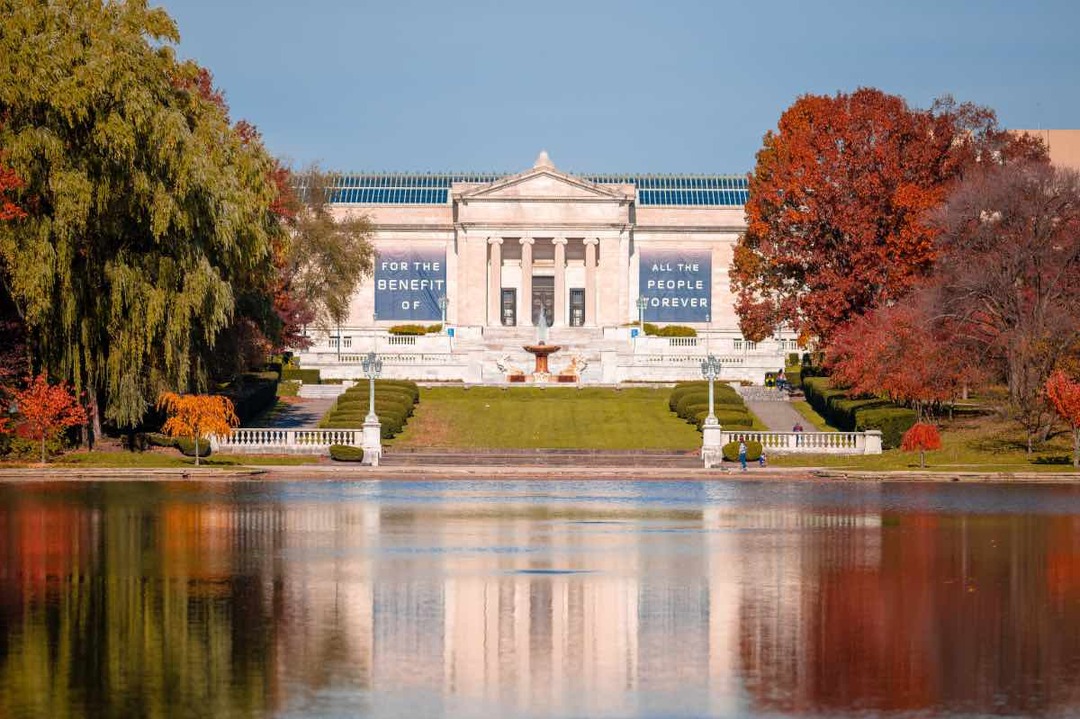
University Circle is a one-square-mile concentration of cultural and educational institutions that may have no real parallel in any American city. Within its borders sit the Cleveland Museum of Art, Cleveland Museum of Natural History, Cleveland Institute of Music, Cleveland Institute of Art, Severance Hall (home of the Cleveland Orchestra), Case Western Reserve University, and the flagship campus of University Hospitals — all within walking distance of each other.
The concentration was not accidental. A 1906 benefaction from industrialist Jeptha Wade established the Wade Park lagoon and the grounds for what would become the art museum; successive industrialist families (Severance, Hanna, Mather) donated land, buildings, and endowments to cluster their institutions around the park. The result is that a city of Cleveland's size supports an institutional ecosystem that more populous cities cannot match — a quiet but remarkable feature of the built environment.
West Side · Established c. 1880
Gordon Square Arts District · Irish, Italian & Appalachian heritage
Detroit Shoreway stretches along Detroit Avenue between the Cuyahoga and Edgewater Park, an old streetcar neighborhood of modest frame houses, corner bars, and immigrant parishes. Gordon Square, its central commercial node, was restored in the 2000s through a coalition of community development corporations, the Cleveland Public Theatre, and the Capitol Theatre's rehabilitation as an independent film house.
The neighborhood's proximity to the lakefront (it borders Edgewater Park to the north) and the substantial arts programming of the Gordon Square Arts District have made it one of the strongest examples of arts-led community revitalization in the city. It remains economically diverse and architecturally intact, two conditions that are increasingly rare in working-class American neighborhoods.
East Side · Established c. 1870
Italian & Slovenian rail-town heritage
Collinwood developed around the Lake Shore & Michigan Southern Railway's immense rail yards on Cleveland's northeast edge. At their peak, the Collinwood Yards employed thousands of men and were one of the largest rail switching operations in the country. Italian and Slovenian immigrants settled along East 152nd Street and Waterloo Road to be close to the work, and those commercial corridors still reflect the early-20th-century rail-town street grid.
The neighborhood's more recent fame comes from the 2008 rebirth of the Waterloo Arts District, a stretch of galleries, music venues, and independent shops organized around the Beachland Ballroom — a converted Slovenian social hall that became one of the most influential indie music venues in the Midwest after its 2000 opening.

The Archive
Every street, every fire, every forgotten face. The stories that don't make the headlines are often the ones worth keeping.