Hough · East 79th and Hough Avenue, 1966
In the Archive · A Turning Point
July 18 — 23, 1966
Six days of unrest in July 1966 ended with four people dead, thirty injured, two hundred and forty fires set, and three hundred people arrested. The Hough Uprising was the second of the major urban uprisings of the long hot summer of 1966, falling between the Watts Uprising of the previous August and the Detroit and Newark uprisings of the following year. It transformed Cleveland politics overnight, and it hollowed out a neighborhood the city has not yet fully rebuilt.
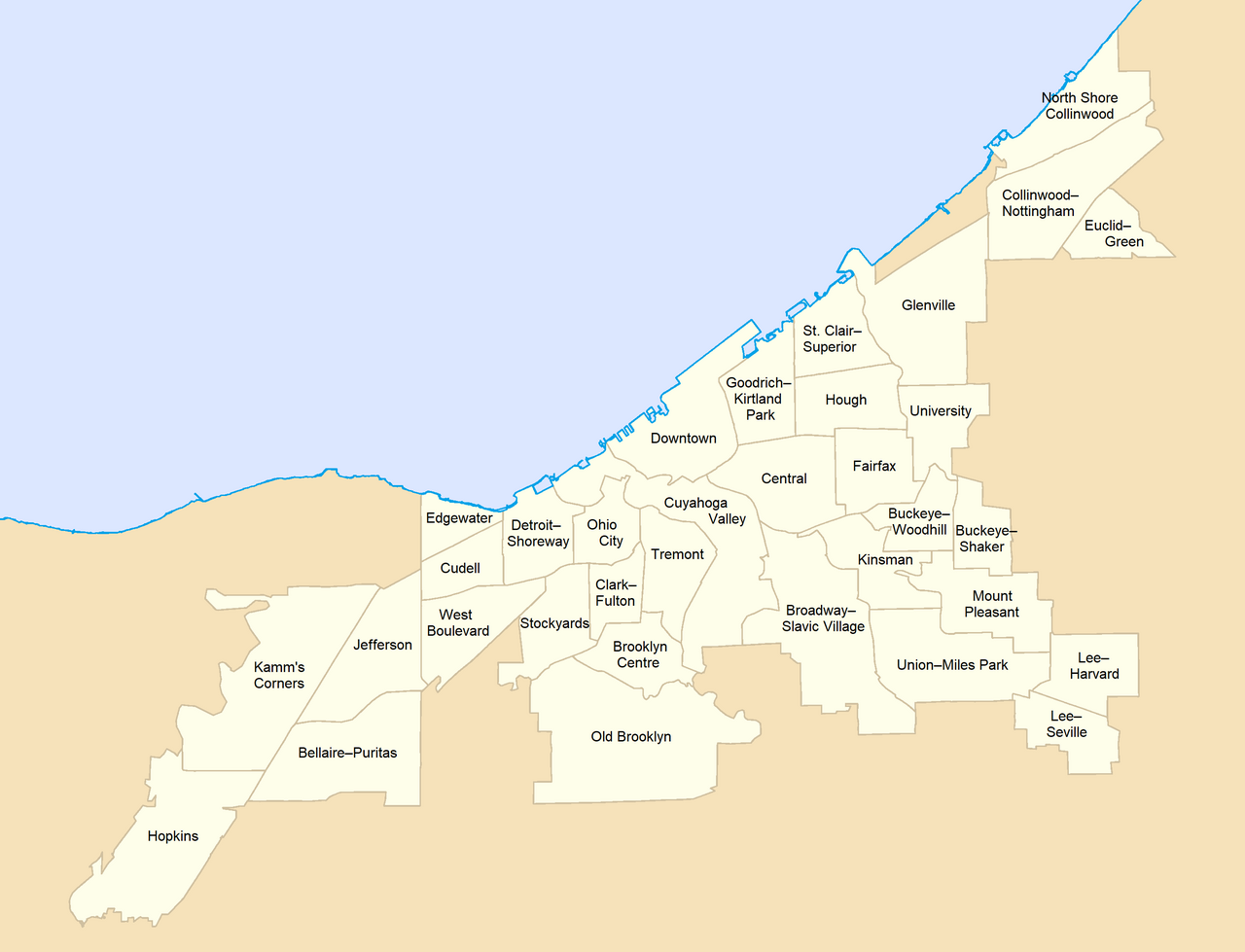
Hough was not a historically Black neighborhood. At the turn of the twentieth century, it was one of Cleveland's most desirable streetcar suburbs — substantial brick homes on wide avenues, close to University Circle and the institutions being built on it. Between 1940 and 1960 the neighborhood's racial composition reversed entirely. White residents left for the outer suburbs; Black residents, largely excluded from those suburbs by restrictive covenants, moved into the only neighborhoods where housing was available. By 1960, Hough was roughly 75% Black and one of the most densely populated residential neighborhoods in the city.
The housing stock, built for a different era, had not been maintained. Absentee landlords divided single-family homes into four, five, six units. Overcrowding was routine. Basic services — trash collection, street maintenance, police protection — were visibly worse than in other parts of the city. The 1960 census recorded a Hough unemployment rate of 14.9% against a citywide rate of 4.3%. Infant mortality was double the city average.
A 1965 Plain Dealer investigation found that of 400 Hough-area rental buildings it surveyed, over 80% had at least one housing-code violation that the city had failed to pursue. The patterns of disinvestment were not incidental; they were policy.

The political consequences were immediate. Mayor Ralph Locher, who had been in office since 1962, had presided over what was widely seen as civic failure. Black voters registered at unprecedented rates. The Call & Post, Cleveland's Black newspaper, endorsed a young state representative named Carl Stokes for mayor in 1967. The Locher administration blamed the uprising on outside agitators and on a Communist conspiracy; a federal grand jury investigation found no evidence to support the claim.
In November 1967, Carl Stokes defeated Republican Seth Taft to become the first Black mayor of a major American city. The Hough Uprising was, in a direct political sense, the event that made his election possible — both by mobilizing Black voter turnout and by discrediting the incumbent administration.
The neighborhood's physical recovery was far slower, and in some respects has not happened. Fires continued at elevated rates through the 1970s, much of it attributed to arson for insurance proceeds by absentee landlords seeking to exit properties that had lost value. Population declined sharply. By 1980, Hough's population was less than half what it had been in 1960. In the 1990s and 2000s, infill housing construction — some subsidized, some part of Case Western Reserve's eastward expansion — began to slowly rebuild the streetscape. The neighborhood remains, sixty years later, a visible and ongoing test of whether American cities can meaningfully recover from the patterns of disinvestment that produced July 1966.
The Archive