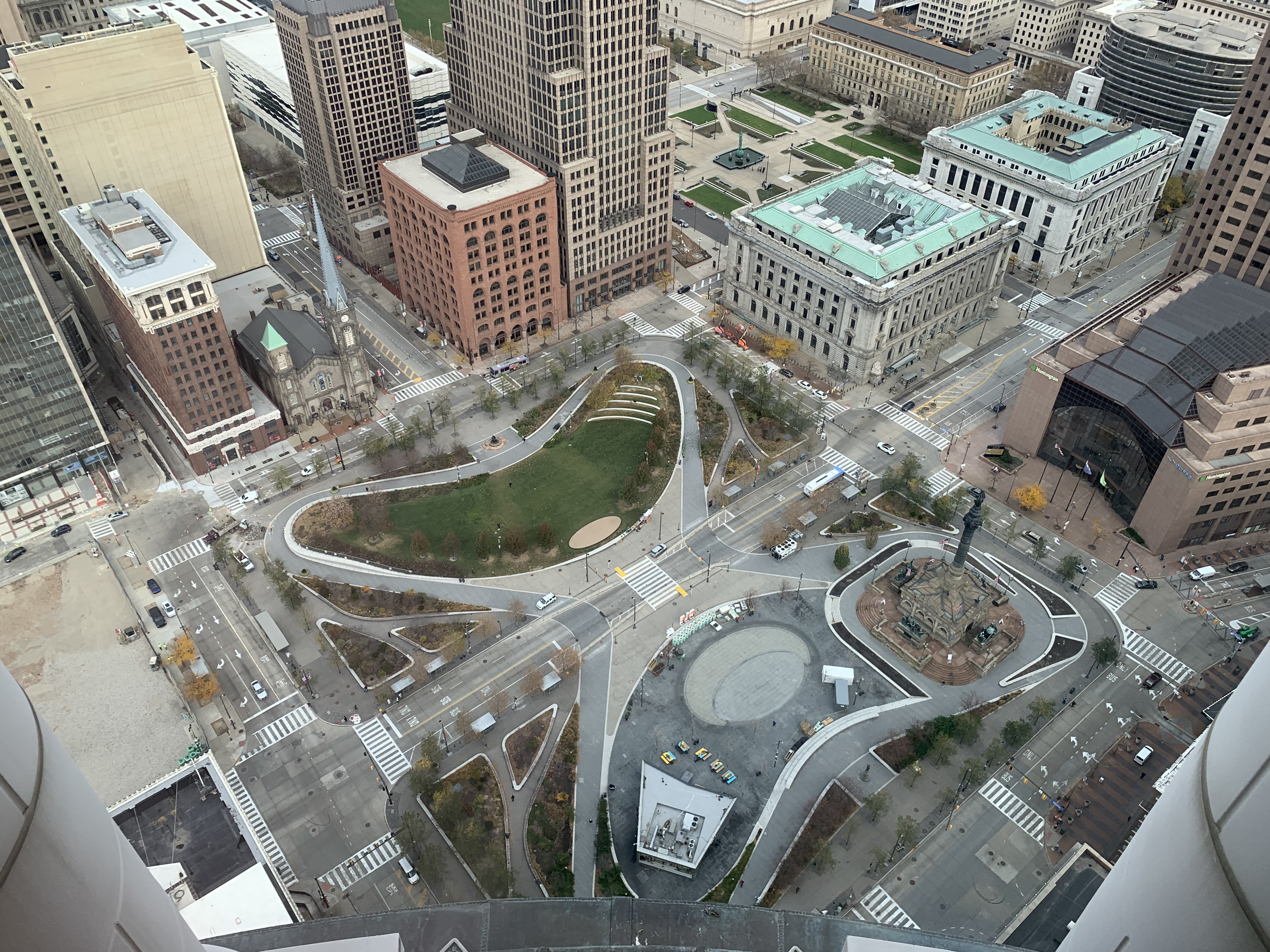
Public Square, redesigned 2016 · The civic center of a city that rebuilt itself
In the Archive · 1978 to Present
On December 15, 1978, Cleveland became the first major American city to default on its financial obligations since the Great Depression. The city could not repay $15.5 million in short-term notes to six local banks. Mayor Dennis Kucinich, 32 years old, refused to sell the municipal electric utility to cover the debt. The banks called the loans. The city defaulted. National news covered it as the end of Cleveland. It was not. This is the story of what happened next.
The years between the default and the end of the 1980s were the hardest in Cleveland's modern history. Population, which had peaked at 914,808 in 1950, fell to 573,822 by 1980 and continued falling. The steel industry collapsed: Republic Steel closed its Corrigan-McKinney works in 1984, Jones & Laughlin closed Cleveland Works in 1984, LTV filed for bankruptcy in 1986. Between 1979 and 1983 alone, greater Cleveland lost 112,000 manufacturing jobs.
Downtown was visibly in retreat. The Hollenden Hotel had been gone since 1962; the Hippodrome Theater came down in 1981; dozens of smaller buildings followed. Euclid Avenue, once the grand spine of the city, became a corridor of boarded storefronts and surface parking. The Cleveland Press, one of two major daily newspapers, folded in June 1982. National magazines routinely ran features headlined some variation of "Can Cleveland Survive?"

Mayor George Voinovich, elected in 1979 on a recovery platform, brought the city out of default through five years of aggressive budget management and a rebuilt relationship with the banking community. By the mid-1980s, Cleveland was solvent. The visible recovery, however, would take another decade.
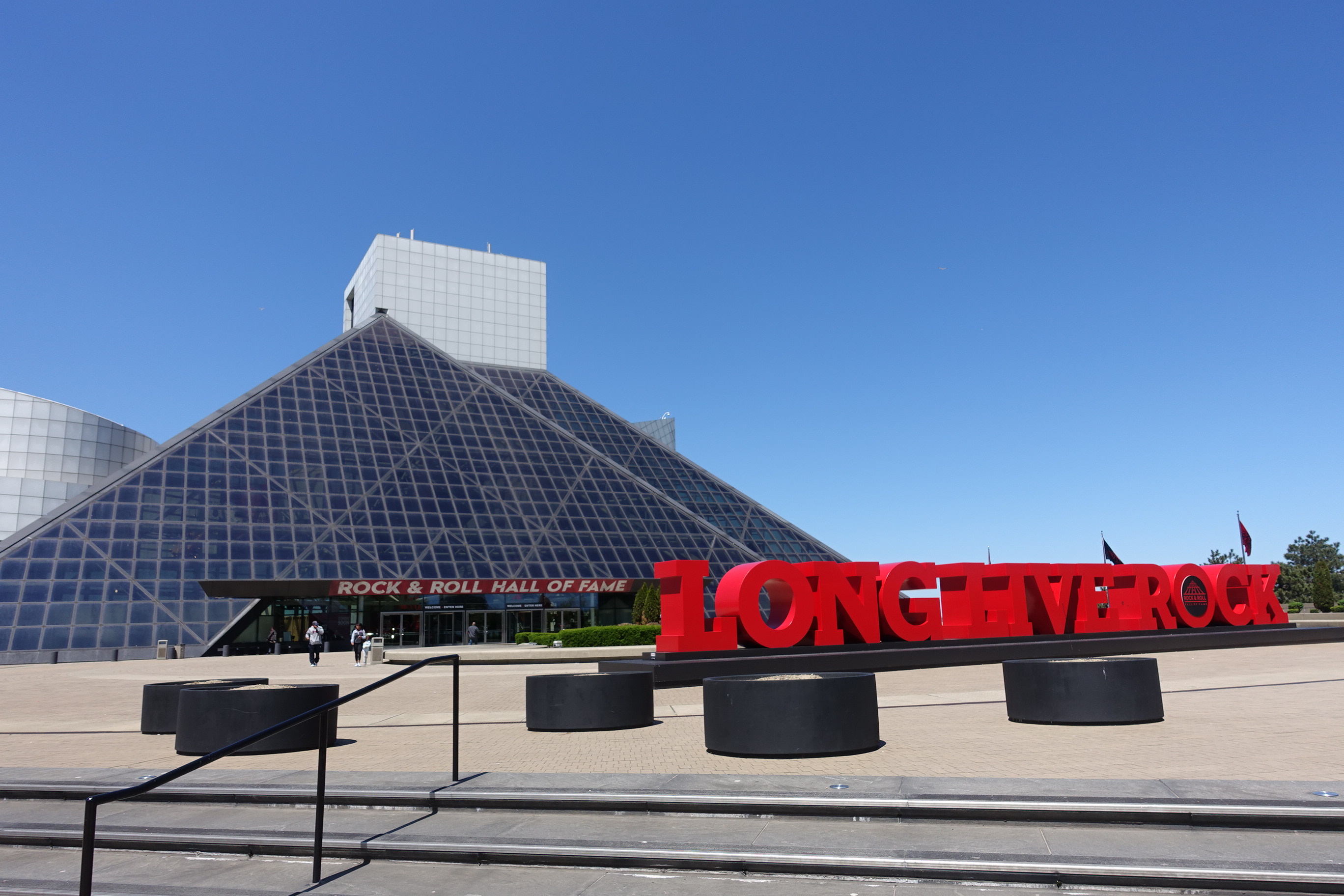
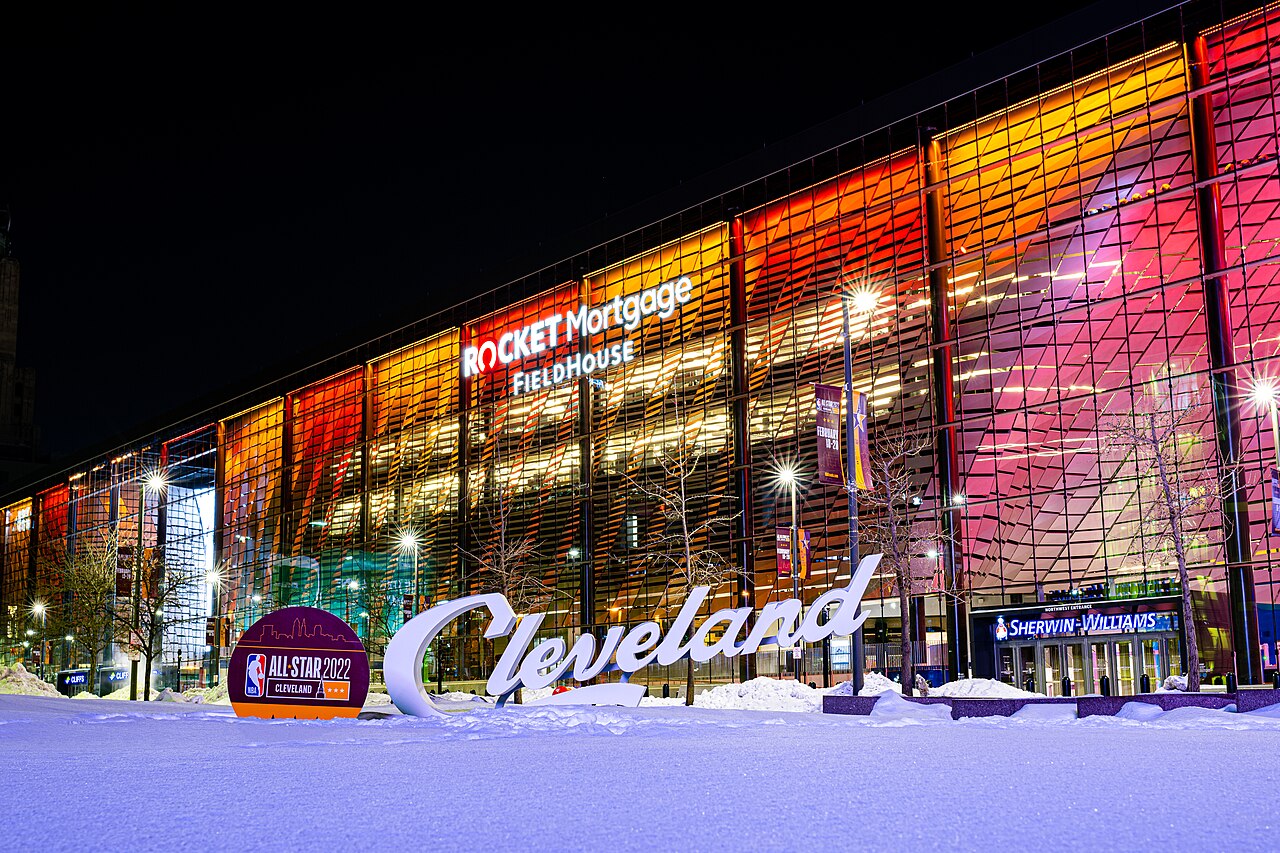
The 1990s brought a cluster of civic projects that, taken together, reshaped what was possible. Tower City Center reopened in 1990 as an adaptive reuse of the Union Terminal complex. The Gateway Project broke ground in 1992, producing Jacobs Field (now Progressive Field, 1994) and Gund Arena (now Rocket Arena, 1994) in downtown's southeast quadrant. The Rock & Roll Hall of Fame opened on September 2, 1995, I.M. Pei's glass pyramid asserting Cleveland's claim on American cultural history.
The Flats reinvented itself as an entertainment district, the Warehouse District began its residential conversion, and the first wave of what would become the downtown residential population (fewer than 5,000 in 1990, over 20,000 by 2020) took hold. The Browns' relocation to Baltimore in 1996 was a severe civic blow, but the city's successful campaign for an expansion franchise — and the new stadium that came with it, opened in 1999 — signaled that Cleveland could still win fights it was expected to lose.
The 2000s saw Cleveland's economic base begin a transformation that was not complete and is still not complete, but is real. The Cleveland Clinic, already one of the country's premier medical institutions, more than doubled in size on its University Circle main campus. University Hospitals, Case Western Reserve, MetroHealth, and the VA hospital expanded alongside it. By 2015, the "Eds and Meds" cluster — education and medicine — had replaced manufacturing as Cleveland's largest employment base, with over 125,000 jobs in the sector.
The 2008 financial crisis hit hard. The Slavic Village ZIP code (44105) led the nation in foreclosures. But the recovery from 2010 onward was, neighborhood by neighborhood, broader than anyone had expected in the 1990s. Ohio City's West Side Market district, Tremont's Lincoln Park, Detroit Shoreway's Gordon Square, and Collinwood's Waterloo all saw genuine mixed-use revivals.

The Cavaliers' NBA championship on June 19, 2016, and the Republican National Convention the following month, framed Cleveland's national re-emergence. The Public Square redesign opened that summer, converting the city's 220-year-old civic center from a traffic island back into a walkable public space. The opioid crisis, on the other hand, hit Cuyahoga County harder than most of the United States, and the City of Cleveland's population — which had stopped falling in 2010 at around 396,000 — continued to decline, reaching 362,656 in the 2020 Census.
The Bibb administration (elected 2021) has made the North Coast lakefront its signature civic initiative, issuing a 2025 Request for Qualifications for the redevelopment of North Coast Yard — the largest undeveloped urban lakefront site in the United States. Whether that corridor delivers on the promise of connecting downtown to the water is the next chapter of the comeback story.
None of this is complete. Cleveland is still less populous, less wealthy, and more racially unequal than it was in 1950. But it is also a city that the 1978 skeptics would not recognize — a city with more residents downtown than it has had since World War II, more internationally ranked institutions than nearly any city its size, and a cultural identity that the preservation of Playhouse Square and the opening of the Rock Hall helped, decade by decade, to rebuild.
The Archive